Arturia Rev OCEAN: Diving Into the Deepest FDN Reverb Yet
The landscape of digital spatial processing is undergoing a profound transformation as we move deeper into 2026. We are witnessing a shift where reverb is no longer just a tool for placing a sound in a room; it is becoming a primary instrument for textural synthesis and atmospheric storytelling. Arturia, a company that has consistently remained at the forefront of this evolution, is reshaping our expectations once again with the release of Rev OCEAN. This plugin represents more than just another addition to the producer’s toolkit; it is a specialized feedback-delay-network (FDN) reverberator designed to turn static audio into fluid, ever-evolving sonic environments.
As we look to the future of sound design, the demand for "living" textures has never been higher. Producers are moving away from static convolution impulses in favor of algorithmic engines that can breathe and react in real-time. Rev OCEAN enters the market at a pivotal moment, offering a sophisticated approach to depth that feels both subaquatic and celestial. By leveraging multi-stage diffusion and a complex web of interconnected delays, Arturia has created a space where reflections don't just decay, they drift, blur, and dissolve into vast beds of sound.
The Architecture of Fluidity: Understanding FDN Reverb
At the heart of Rev OCEAN lies a state-of-the-art Feedback Delay Network (FDN). Unlike traditional algorithmic reverbs that might rely on simple feedback loops, an FDN uses a matrix of interconnected delay lines where the output of each delay is fed back into the inputs of all others. This creates a dense, complex web of reflections that mimics the chaotic yet harmonious behavior of real-world acoustic spaces. We are seeing this technology become the gold standard for high-end ambient processing because it avoids the "metallic ringing" often associated with lesser digital reverbs.
Beyond the core engine, Arturia has implemented multi-stage diffusion to ensure the reverb tail remains cohesive and smooth, regardless of how long the decay is pushed. This is crucial for modern production styles where clarity is just as important as scale. Whether you are working on a minimalist techno track or a lush cinematic score, the FDN architecture ensures that the spatial depth feels stable and "mix-ready" from the first touch.
Pristine FDN Processing: A matrix-based delay network that provides a dense, stable, and highly musical decay that avoids common digital artifacts.
Multi-Stage Diffusion: Multiple layers of "smearing" that transform distinct echoes into a singular, flowing cloud of sound.
Hyper-Fluid Tails: The engine is tuned specifically for movement, ensuring that the stereo image is constantly shifting and evolving over time.
Three Expressive Modes: Abyss, Tide, and Foam

While the underlying engine provides the stability, the true character of Rev OCEAN is defined by its three distinct modulation modes. Each mode acts as a different "current" that shapes how the reverb tail behaves and evolves. This level of macro-control allows us to quickly pivot from traditional spatial enhancement to radical sound design without menu-diving.
Abyss: The Depth of Reverse Textures
The Abyss mode is designed for those moments when you need a reverb that feels haunting and cinematic. It incorporates layered reverse textures and subtle pitch-shifting into the tail, creating a "shimmer" that feels more organic and less "crystalline" than traditional octave-up effects. As we push the Macro slider in this mode, the reverb begins to rise and swell beneath the source material, providing a sense of foreboding depth that is perfect for transitions or ambient pads.
Tide: Modulated Spectral Motion
For producers looking to add a sense of life to static keys or guitars, Tide is the go-to setting. It applies independent, modulated filtering to the left and right channels, creating a wave-like spectral motion. This phase-like movement ensures that the reverb tail never sounds the same twice, effectively preventing "ear fatigue" in long, atmospheric tracks. It is a subtle yet powerful way to make a digital production feel more "analog" and unpredictable.
Foam: The Art of Diffused Swells
Foam is perhaps the most unique of the three, focusing on the attack phase of the reverb. It uses a long, blurred attack and heavy diffusion to soften transients, making it ideal for the "shoegaze-haze" aesthetic. When we apply Foam to a plucked synth or an arpeggiated guitar, the initial hit is dissolved into a cloud-like texture that blooms gradually. This allows the source to stay "dry" and clear in the mix while the atmosphere builds up behind it.
Practical Utility for the Modern Mix
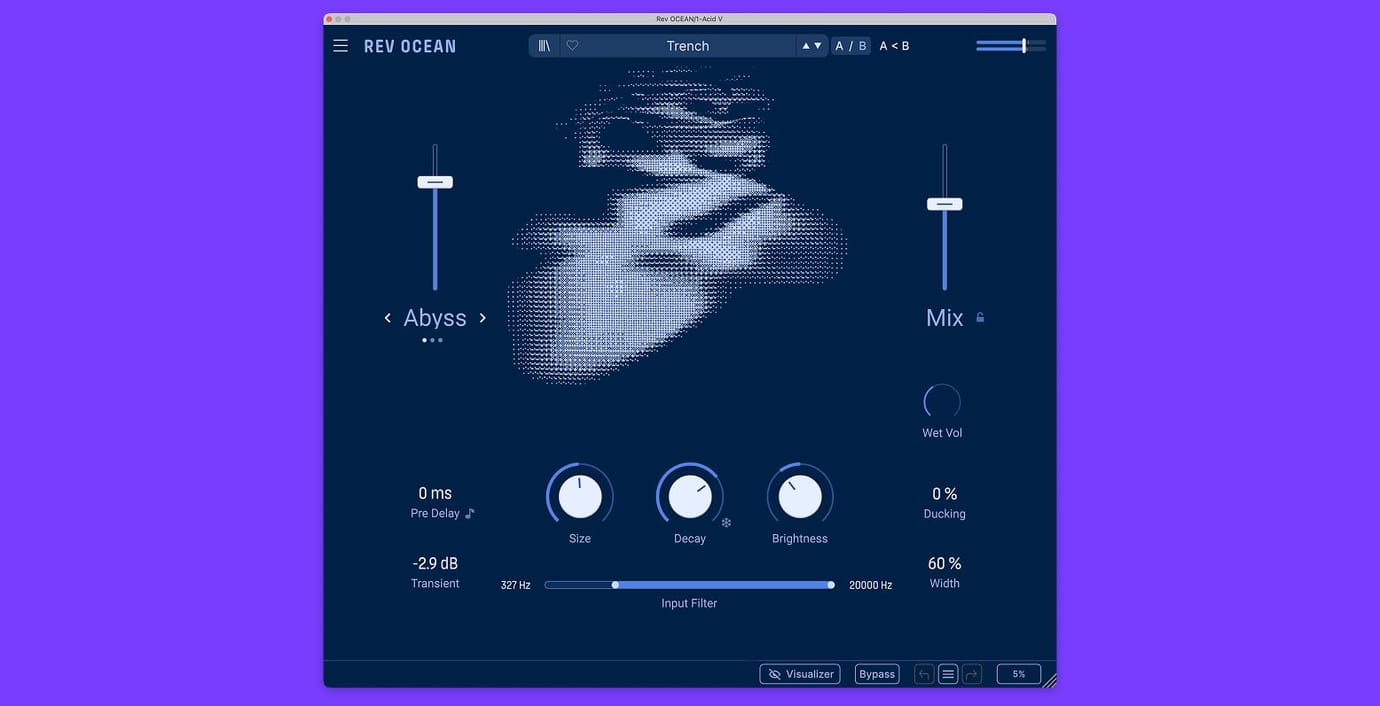
It is easy for a "creative" reverb to become a wash that ruins a mix, but Arturia has included several utility features to prevent this. We are seeing a trend in modern plugin design where "corrective" tools are built directly into the creative interface, and Rev OCEAN is a prime example. The inclusion of dedicated Ducking and Transient controls means that you don't need to reach for a separate sidechain compressor or envelope shaper to keep your drums or vocals clear.
Integrated Ducking: Automatically lowers the reverb volume when the source signal is present, ensuring that the "dry" sound remains front-and-center.
Transient Shaping: Allows you to soften the sharp attacks of the incoming audio before they hit the reverb tank, preventing "clicky" reflections on percussive material.
Input Filtering: High-pass and low-pass filters allow you to "tame the tank," removing muddy lows or piercing highs before they are processed by the FDN engine.
Freeze Function: A dedicated "snowflake" icon that holds the reverb tail indefinitely, enabling the creation of infinite drones and suspended atmospheres.
Integration Within FX Collection 6 Pro
Rev OCEAN arrives not just as a standalone powerhouse, but as a key component of the newly updated FX Collection 6 Pro. This suite now contains 39 world-class effects, ranging from legendary analog emulations to futuristic digital processors like the Polyfreq Phonon. By including Rev OCEAN in this collection, Arturia is positioning it as a fundamental part of a modern mixing workflow, sitting alongside essential tools like the Bus FORCE and the Dist OPAMP-21.
For producers who are already leveraging tactile systems like the Softube Flow Studio, the MIDI-mappable nature of Rev OCEAN makes it an ideal candidate for hands-on performance. Sweeping the Macro slider or automating the Freeze function in real-time can lead to "happy accidents" that are often lost when clicking around with a mouse.
Pricing, Availability, and Final Thoughts
As we continue to explore the intersection of AI and traditional synthesis, a topic we recently covered in our analysis of AI Mixing vs. AI Mastering in 2026, tools like Rev OCEAN remind us of the value of human-led creative exploration. While AI can assist in the technical aspects of a mix, the emotional "vibe" of a track often comes from these specialized, characterful processors.
Arturia is currently offering Rev OCEAN at a launch price of $49, a significant discount that is available until July 14. For those looking for the complete package, the FX Collection 6 Pro remains the definitive choice, providing a comprehensive library of sounds that will serve any production style for years to come.
In conclusion, Rev OCEAN is a testament to how far algorithmic reverb has come. It successfully balances technical sophistication with an intuitive, "ocean-inspired" interface that encourages experimentation. Whether you are looking to submerge your drums in a rhythmic wash or dissolve a vocal into an infinite abyss, this plugin provides the tools to do so with unparalleled clarity and motion. The future of sound is fluid, and Arturia is leading the way into the deep.
Sources: