AI Mixing vs. AI Mastering in 2026: OSMIX vs. Landr (and When to Use Each)
Updated: Apr 6
For Sonny (Social Media Manager):
Published Blog URL: https://www.musictechnologynews.com/post/the-ai-music-wars-suno-warner-deal-songkick-acquisition
Main Hero Image URL: https://cdn.marblism.com/3kDlp2Xn8vT.webp
Coming right up after this one!
DRAFT #3 (Friday) - AI Mixing vs. AI Mastering:
We are standing at a pivotal moment in music production where artificial intelligence is reshaping the final stages of the creative process. In 2026, AI-powered mixing and mastering tools are becoming legitimate workflow components for bedroom producers and professional studios alike. But here's the critical distinction most producers miss: AI mixing and AI mastering are solving fundamentally different problems, and the technology behind each is evolving at vastly different speeds.
Understanding when to use OSMIX for AI mixing versus Landr for AI mastering isn't just about saving money: it's about knowing which parts of your production workflow benefit from automation and which still demand the human touch.
What's Actually Different Between Mixing and Mastering?
Before we dive into the AI tools, let's clear up the confusion that trips up most new producers.
Mixing is the process of balancing and processing individual tracks within your project. You're working with 20, 50, sometimes 100+ separate audio files: drums, vocals, synths, guitars: and making thousands of micro-decisions about volume, panning, EQ, compression, reverb, and effects. The goal is to create a cohesive stereo mix where every element has its place and nothing fights for attention. This is where the song takes shape emotionally and sonically.
Mastering happens after mixing is complete. You're working with a single stereo file (your final mix) and applying subtle processing to ensure it sounds consistent across playback systems, meets loudness standards for streaming platforms, and translates well from earbuds to car speakers to club sound systems. Mastering is the final polish: think of it as quality control plus sonic optimization.
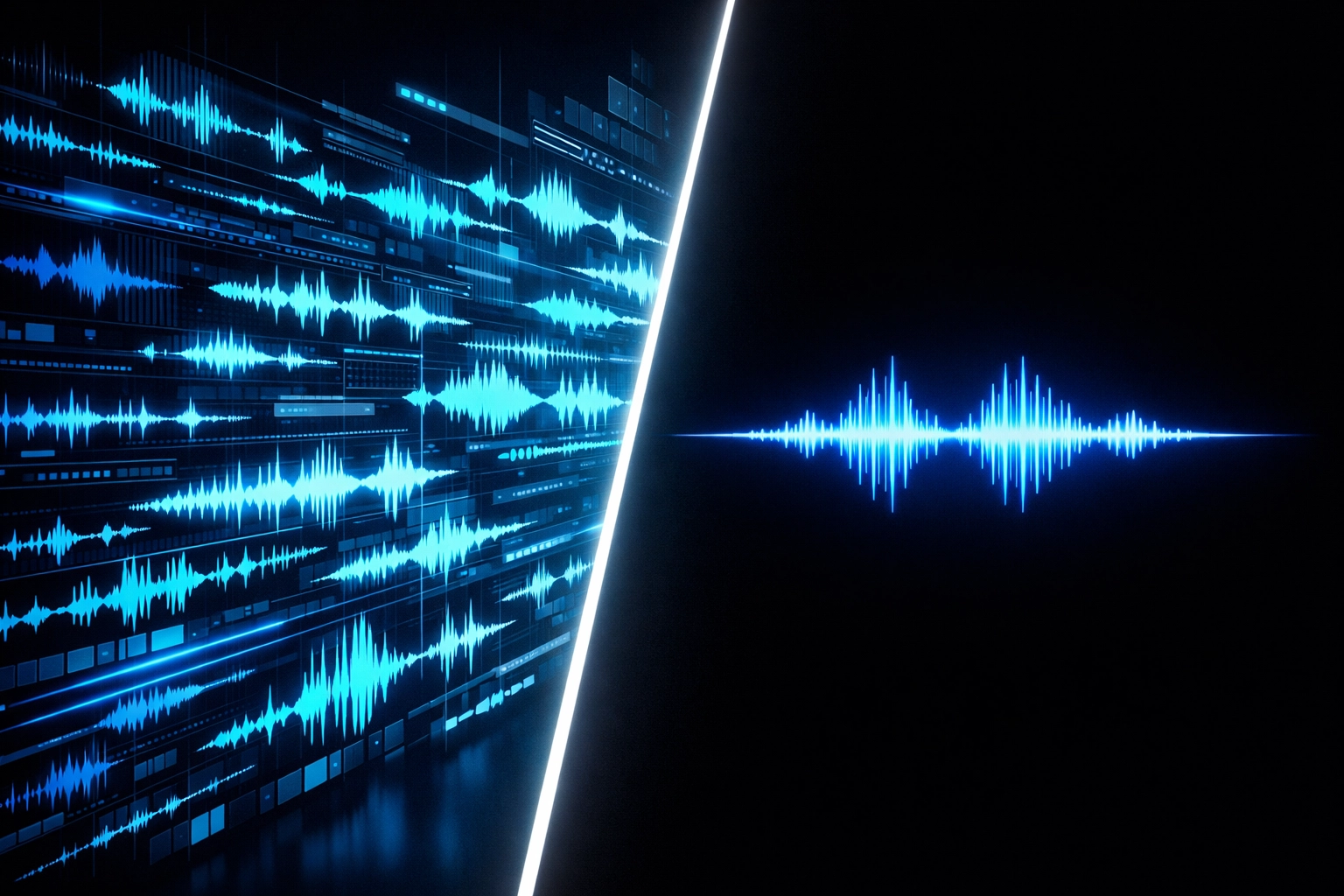
The complexity gap between these two processes is enormous, which is why AI has succeeded dramatically in one area while still struggling in the other.
AI Mastering: Landr and the Solved Problem
Landr has processed millions of tracks since launching in 2014, and by 2026, AI mastering is a legitimately solved problem for most use cases. The platform analyzes your stereo mix, identifies frequency imbalances, applies corrective EQ, adds multi-band compression, handles limiting for loudness standards, and outputs a professionally mastered file optimized for Spotify, Apple Music, YouTube, and physical formats.
The reason AI mastering works so well is simple: the decision space is manageable. When you're working with a single stereo file, the AI has a limited set of variables to analyze and adjust. It's checking for:
Overall frequency balance (is it too muddy in the low-mids? Too harsh in the highs?)
Dynamic range (does it need compression to glue elements together?)
Loudness targets (meeting -14 LUFS for streaming without destroying dynamics)
Stereo width (ensuring mono compatibility while maintaining spaciousness)
Landr's AI has been trained on countless reference tracks across genres, so it understands what a "finished" track should sound like in hip-hop versus EDM versus indie rock. The results are consistently good: not always perfect, not always as nuanced as a human mastering engineer with $50,000 worth of analog gear, but absolutely serviceable for independent releases, content creators, and high-volume production scenarios.
When Landr excels:
Sample library creators who need to master hundreds of loops with consistent loudness
YouTube producers who need quick turnaround for weekly content
Independent artists releasing singles without major-label budgets
Podcast producers who need broadcast-quality audio without hiring an engineer
The pricing is transparent: $5-$20 per track depending on quality tier, or subscription models for unlimited processing. For most bedroom producers, this is a no-brainer compared to $50-$150 per song from a human mastering engineer.
AI Mixing: OSMIX and the Unsolved Frontier
Here's where things get complicated. OSMIX represents the cutting edge of AI mixing technology in 2026, but even the most advanced AI mixing tools are still wrestling with a problem that's exponentially harder than mastering.

When you feed OSMIX a multi-track session, the AI is attempting to:
Balance levels across dozens or hundreds of individual tracks
Apply context-aware EQ (cutting frequencies on the bass that conflict with the kick, boosting presence on vocals without making them harsh)
Add compression that responds to the unique dynamics of each instrument
Make panning decisions that create width without causing phase issues
Apply reverb and delay that enhances space without creating mud
Handle the downstream effects where every decision impacts every other decision
This is not a linear process. Changing the vocal volume affects how the guitars sit in the mix. Adding compression to the drums changes how the bass needs to be EQ'd. Boosting the high end on the snare might make the hi-hats too piercing. Human mixing engineers spend years developing the instinct to navigate these interconnected decisions: and even in 2026, AI is still learning.
What OSMIX actually does well:
OSMIX shines as an AI-assisted mixing tool rather than a fully autonomous solution. It analyzes your tracks, suggests starting points for levels and EQ, identifies potential problem areas (like frequency masking or phase cancellation), and offers one-click presets for common scenarios. For bedroom producers who understand mixing fundamentals but lack the experience or monitoring environment to make confident decisions, OSMIX is transforming workflows.
The platform integrates directly with major DAWs (more on that below), meaning you're not bouncing stems and uploading them to a web interface. You're working within your project, using OSMIX as an intelligent assistant that speeds up the grunt work while you focus on creative decisions.
Where OSMIX still needs human oversight:
Without final human adjustments, AI-only mixes from any platform: including OSMIX: tend to sound technically acceptable but emotionally generic. The AI might balance everything perfectly, but it doesn't understand that sometimes you want the vocal to be slightly too loud because that's the artist's signature style. It might apply textbook compression, but it won't know when to break the rules for dramatic effect.
The Bedroom Producer's 2026 Workflow
Here's how smart producers are using AI mixing and mastering tools together in 2026:
Phase 1: Production and Arrangement You're recording, programming, layering tracks in your DAW. AI isn't involved yet: this is pure creativity.
Phase 2: AI-Assisted Mixing (OSMIX) Once your arrangement is solid, you run OSMIX's analysis. It identifies obvious problems (vocals buried under guitars, kick and bass fighting in the low end) and suggests corrective moves. You accept some, reject others, use the AI's suggestions as a starting point for your own adjustments. You're saving hours on the tedious technical work while maintaining creative control.
Phase 3: Final Mix Polish You make artistic decisions the AI can't handle: adding that weird distortion effect on the chorus vocals, automating volume rides for emotional impact, choosing reverb that matches the song's vibe.
Phase 4: AI Mastering (Landr) You bounce your final mix, upload it to Landr, select your genre and intensity preferences, and receive multiple mastered versions to compare. You choose the one that sounds best on your monitoring setup and streaming devices.
Total cost: OSMIX subscription ($20-$40/month) + Landr per-track ($10-$20) = professional-sounding release for a fraction of traditional studio costs.

DAW Integration: The Game-Changer
The biggest workflow improvement in 2026 isn't the AI algorithms themselves: it's how these tools integrate with your existing production environment.
OSMIX offers native plugins for Ableton Live, FL Studio, Logic Pro, and Pro Tools. You're not exporting stems, uploading them to a website, waiting for processing, then re-importing. You're running analysis and applying suggestions directly within your session, with full undo/redo, A/B comparison, and the ability to tweak parameters in real-time.
Landr still operates primarily as a web-based service (you upload a stereo file), but they've added Dropbox and Google Drive integration for automated workflows. Finish your mix, save to a watched folder, and Landr automatically processes and returns mastered versions to your desktop: no manual uploading required.
This seamless integration is what's making AI audio tools viable for professional workflows rather than just hobbyist novelties.
The Honest Pros and Cons Breakdown
AI Mastering (Landr) Pros:
Consistently good results across genres
Affordable ($5-$20 vs. $50-$150 for human engineers)
Fast turnaround (minutes vs. days)
Multiple loudness/platform optimizations included
Perfect for high-volume production needs
AI Mastering Cons:
Lacks the subtle character and artistic choices of top-tier human mastering
Cannot fix fundamental mix problems (if your mix is muddy, AI mastering won't save it)
Limited ability to understand context or artist intent
Standardized approach may not suit experimental or genre-bending music
AI Mixing (OSMIX) Pros:
Dramatically reduces time spent on technical grunt work
Identifies problems human ears might miss (phase issues, frequency masking)
Provides objective analysis when you've lost perspective from listening fatigue
Affordable compared to hiring a mixing engineer
Great educational tool for learning mixing fundamentals
AI Mixing Cons:
Still requires human oversight for emotionally resonant results
Cannot match the artistic nuance of experienced human mixers
May struggle with unconventional production choices
Generic-sounding results without final human adjustments
Learning curve to understand which AI suggestions to accept vs. reject
Pricing: What You're Actually Paying For
Landr Mastering:
Single track: $9-$15 (standard quality)
Single track: $19 (HD quality with stems)
Monthly subscription: $12.50/month (unlimited standard mastering)
Annual subscription: $9/month billed annually
OSMIX Mixing:
Free tier: Limited analysis and processing
Pro tier: $29/month (unlimited projects, full feature set)
Studio tier: $49/month (includes advanced features, priority processing)
Human alternatives for comparison:
Professional mixing engineer: $200-$500 per song
Professional mastering engineer: $50-$150 per song
Full production package (mixing + mastering): $300-$800 per song
The math is obvious for independent artists working on tight budgets, but there's a critical consideration: AI tools are not a direct replacement: they're a different workflow with different outcomes.
Alternatives Worth Considering
For AI Mastering:
iZotope Ozone (desktop software with AI-powered mastering assistant, more control than Landr)
CloudBounce (similar web-based service to Landr)
eMastered (backed by Grammy-winning engineers, slightly more expensive but excellent results)
For AI Mixing:
iZotope Neutron (focuses on single-track processing with Mix Assistant feature)
Sonible smart:comp/smart:EQ (context-aware processing for individual tracks)
Waves StudioRack with AI suggestions (not full mixing automation, but intelligent plugin recommendations)
None of these offer the same end-to-end AI mixing workflow that OSMIX is pioneering, but they provide powerful AI-assisted processing within traditional mixing approaches.
Human Engineer vs. AI: When to Choose What
This is the question that actually matters. Here's the honest answer in 2026:
Choose AI mastering (Landr) when:
You're releasing content regularly and need consistent quality at scale
Your mix is already solid and just needs final polish
Budget constraints make $50-$150 per song mastering unrealistic
You're producing for YouTube, podcasts, sample libraries, or game audio where "good enough" genuinely is good enough
You're learning and want to study what professional mastering does to your mixes
Choose human mastering when:
It's a flagship single or album where maximum quality justifies the cost
You're working with complex or experimental material that benefits from human interpretation
You want creative collaboration on the final sound (analog warmth, specific character, artistic choices)
Distribution partners or labels require human engineer credits
You need someone who can identify and fix underlying mix problems
Choose AI mixing (OSMIX) when:
You understand mixing fundamentals and need a faster workflow
You want objective analysis and suggestions to improve your technical skills
Budget doesn't allow for professional mixing ($200-$500 per song)
You're willing to do final polish and artistic tweaks yourself
You need quick turnaround for content creation or client work
Choose human mixing when:
The music demands artistic interpretation and emotional nuance
You lack the technical foundation to evaluate and refine AI suggestions
It's a career-defining release where mixing quality is non-negotiable
You're working in genre-blending or experimental territory
You value the collaborative creative process with an experienced engineer

Best Practices for 2026
If you're going the AI route for mixing and mastering, follow these guidelines to maximize quality:
Before AI Mixing:
Clean up your session (remove unused tracks, consolidate regions, organize tracks logically)
Ensure proper gain staging (nothing clipping, everything with healthy signal)
Make rough level adjustments so the AI isn't starting from complete chaos
Apply your creative effects and processing: let AI handle the technical balancing
After AI Mixing:
Always do critical listening on multiple playback systems before considering it "done"
Make final artistic adjustments the AI can't handle (automation, creative effects, vibe)
Reference your mix against professional tracks in the same genre
Don't be afraid to reject AI suggestions that don't serve the song
Before AI Mastering:
Leave 3-6 dB of headroom in your final mix (don't slam the limiter)
Check for phase issues and mono compatibility problems
Ensure your mix translates well across playback systems
Remember: AI mastering cannot fix a bad mix: garbage in, garbage out
After AI Mastering:
Listen to the mastered version on earbuds, car stereo, laptop speakers, and studio monitors
Compare multiple mastering presets/intensities if the platform offers them
Consider ordering mastered versions optimized for different platforms (streaming, CD, vinyl)
The Bottom Line
AI mixing and AI mastering are serving different needs in 2026. Landr and similar AI mastering platforms are mature, reliable, and genuinely competitive with human engineers for a large percentage of releases. OSMIX and emerging AI mixing tools are powerful workflow accelerators, but they're not yet autonomous solutions: they're intelligent assistants for producers who understand the craft.
The future isn't AI replacing human engineers: it's AI enabling more people to achieve professional-sounding results while freeing experienced engineers to focus on the creative decisions that actually require artistry and taste. We are witnessing the democratization of music production's final stages, and for independent artists working without major-label budgets, that transformation is nothing short of revolutionary.
Choose your tools based on your skills, your budget, and your goals. And remember: the best mix is the one that serves the song, whether it came from AI, a human engineer, or some hybrid combination of both.