Analogue Solutions Filtopia: The £1,799 Synth with Five Parallel Filters
As we look to the future of sound design in 2026, we are witnessing a profound resurgence in the desire for tactile, boutique instruments that offer more than just a digital replica of the past. We are stepping into an era where the distinction between a simple synthesizer and a specialized sonic laboratory is becoming increasingly blurred. On the brink of this shift, British boutique manufacturer Analogue Solutions has unveiled Filtopia, a handbuilt monophonic analog synthesizer that represents a radical departure from conventional signal paths.
By centering a complete synthesis engine around a formidable bank of five parallel filters, Analogue Solutions is reshaping our understanding of harmonic complexity and frequency manipulation. This isn't merely another entry into the crowded market of studio hardware; it is a limited-edition statement piece: restricted to only 200 units: designed for those who demand a physical connection to their sound that music production software often struggles to replicate with the same raw, electric energy.
A Massive Parallel Architecture
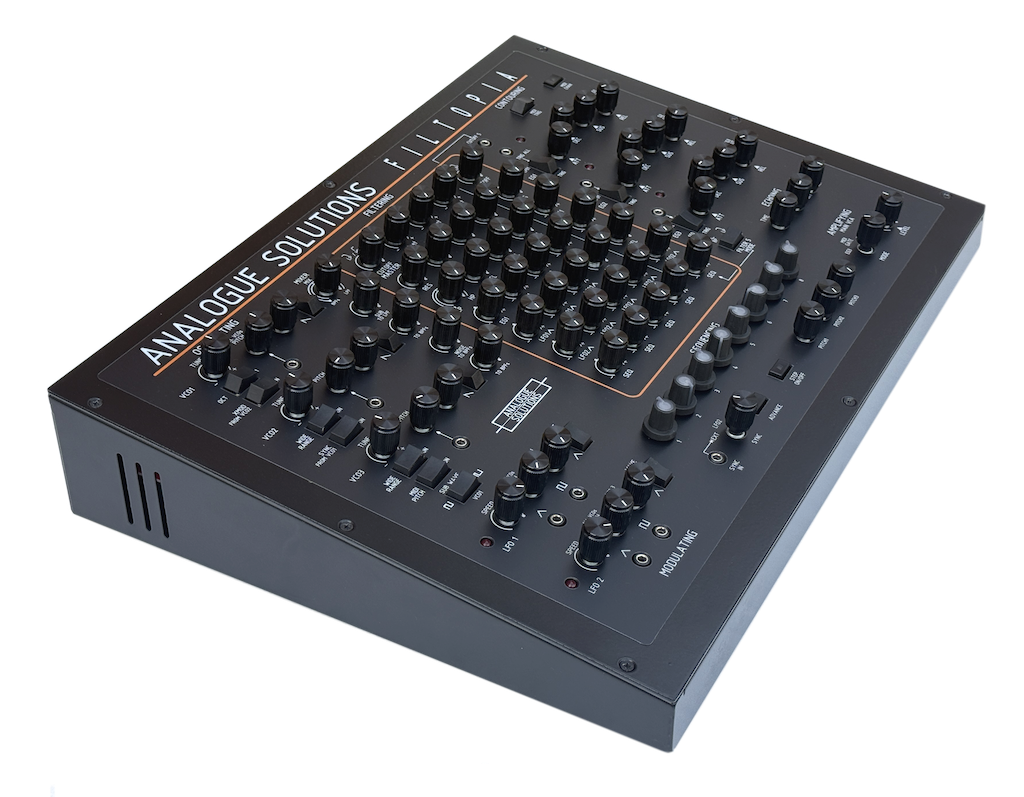
Filtopia is built upon a foundation of uncompromising analog circuitry, designed and hand-assembled in the UK by Tom Carpenter. While many modern synthesizers prioritize polyphony or digital flexibility, we are seeing Filtopia double down on the richness of a single, powerful monophonic voice. The architecture is vast, providing a level of depth that enables sound designers to sculpt timbres that feel alive and constantly evolving.
Triple VCO Power: At the heart of the machine lie three high-quality analog Voltage Controlled Oscillators (VCOs). These oscillators provide the primary harmonic content, offering switchable pulse and sawtooth waveforms that can be detuned and thickened to create massive, wall-of-sound textures.
Dual Sub-Oscillators: To ensure a solid low-end foundation, Filtopia includes two dedicated sub-oscillators. These are crucial for creating the earth-shaking bass tones that have become a hallmark of the Analogue Solutions sound.
Audio-Rate Noise & Ring Modulation: Beyond standard waveforms, the inclusion of an audio-rate noise generator and a true ring modulator allows for the creation of metallic, percussive, and chaotic sounds, expanding the instrument's reach into experimental territory.
The Heart of the Beast: The Five-Filter Bank
The defining characteristic of Filtopia: and its primary USP: is the bank of five parallel 12dB/octave multimode filters. While a standard synthesizer typically routes its oscillators through a single filter (or perhaps two in series or parallel), Filtopia allows for a radical multi-band approach to synthesis. This configuration is inspired by the legendary Oberheim SEM but has been significantly evolved for modern applications.

By having five filters running in parallel, each with its own independent cutoff and resonance controls, we are able to perform complex multi-band sweeps that are physically impossible on traditional instruments.
Filter 1 (Multimode): Located on the far left, this filter features a balance control that allows users to fade seamlessly between Low Pass and High Pass modes.
Filters 2, 3, and 4 (Band Pass): The three central filters are dedicated Band Pass units, perfect for isolating specific frequency peaks and creating resonant "formants."
Filter 5 (Switchable): The final filter on the right is switchable between Low Pass and Band Pass modes, providing a flexible end-point for the signal path.
The practical application of this architecture is immense. By offsetting the cutoff frequencies of these five filters and applying high resonance, we can mimic the resonances of the human vocal tract, enabling the creation of eerie, vowel-like "formant" sounds. This level of vocal-like expression is something we typically only see in high-end music production software or complex modular rigs, yet here it is contained within a single, cohesive piece of studio hardware.
Modulation, Sequencing, and Tactical Control
Beyond its unique filtering capabilities, Filtopia is a fully realized performance instrument. It integrates traditional synthesis controls with modern utility, ensuring it fits perfectly into any contemporary production environment. The modulation matrix is designed to be intuitive yet deep, allowing for the kind of "happy accidents" that define the best analog sessions.
Triple ADSR Envelopes: Three full ADSR (Attack, Decay, Sustain, Release) envelope generators provide precise control over amplitude, filter sweeps, and other modulation targets.
Dual LFOs: Two independent Low Frequency Oscillators (LFOs) with triangle and square waves offer a range of rhythmic and timbral movement, from subtle vibrato to extreme FM-style modulations.
8-Step CV Sequencer: The built-in sequencer provides a classic hands-on approach to melody and modulation. With per-step pitch control and real-time performance features, it serves as a creative catalyst for evolving loops and patterns.
MIDI-to-CV Integration: Despite its analog soul, Filtopia is ready for the digital age. It includes a comprehensive MIDI-to-CV converter, allowing it to be triggered by any DAW or external sequencer, with velocity routing available to control filter parameters dynamically.
A True Stereo Experience
In a world where many monosynths remain strictly monaural, Filtopia embraces a true stereo signal path. It features two Voltage Controlled Amplifiers (VCAs) that feed into left and right outputs, allowing for wide spatial imaging and panning. Furthermore, one of the VCAs is hardwired to an onboard solid-state delay/echo unit.
This integrated delay isn't just a basic effect; it is a fundamental part of the instrument's sound design. It enables the creation of lush, dub-style echoes and spatial depth that complements the complex filtering happening upstream. When combined with external processing: perhaps something like the Arturia Rev Ocean: the sonic potential of Filtopia becomes virtually limitless.
Handbuilt Exclusivity and Studio Integration
As we look toward the "hardware museum" approach to studio building, exemplified by tools like the UVI Synth Anthology 4, Filtopia stands out as a future classic. Its £1,799 price point reflects its status as a premium, hand-built instrument. With only 200 units being produced worldwide, it is destined to become a sought-after piece for collectors and professional sound designers alike.
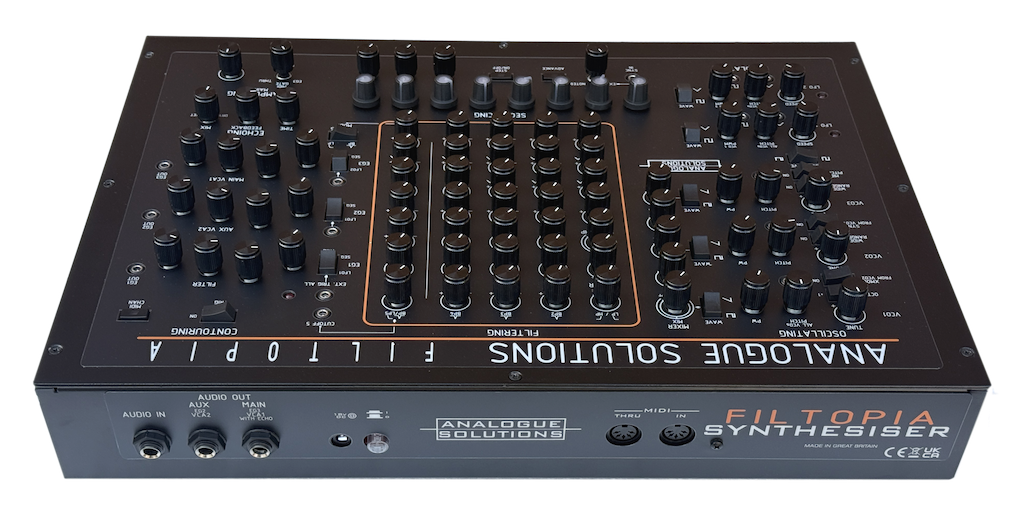
Beyond being a standalone synthesizer, Filtopia functions as a powerful external processor. The inclusion of a 1/4" external audio input allows users to route their existing tracks, drum machines, or other synths through the five-filter bank. This transforms the unit into a high-end analog filter processor, providing a level of "analog warmth" and harmonic character that even the most advanced Carbon Electra 2 patches can benefit from.
The Future of Analog Craftsmanship
The release of Filtopia reminds us that the future of music technology is not solely digital. There is a vital space for instruments that prioritize physical interaction, idiosyncratic signal paths, and the inherent unpredictability of analog electricity. By focusing on parallel filtering, Analogue Solutions has created more than just a synthesizer; they have created a tool that invites exploration and rewards those willing to dive deep into the nuances of frequency and resonance.
Whether you are looking to add a unique character to your music production software workflow or you are searching for the next centerpiece for your studio hardware collection, Filtopia offers a sonic palette that is as rare as the instrument itself. As these 200 units find their way into studios around the world, we expect to hear the results in the form of more expressive, organic, and truly unique electronic music.
Sources: