Suno v6 vs Google Lyria 3.5 vs ElevenLabs Music v2.5: AI Music Generators Compared
The AI music generator market is stepping into a decisive new phase. This week’s releases from Suno, Google, and ElevenLabs are showing that generative music is moving beyond short experiments and novelty clips. Producers are gaining access to longer songs, more convincing vocals, more structured arrangements, and increasingly practical editing workflows.
Suno v6 is arriving as a three-model suite: a polished flagship, an experimental variant, and a faster free option. Google Lyria 3.5 is expanding inside Gemini and through the Gemini API, with stronger control over structure, tempo, and vocal performance. ElevenLabs Music v2.5 is focusing on natural-sounding instruments, layered arrangements, and a commercial-use framework designed for creators and businesses.
So which ai music generator should producers choose? The answer depends on whether we value maximum experimentation, detailed song direction, natural instrumental performances, or integration with an existing production workflow.
At a glance: three different approaches to AI music
The central difference is that these platforms are not solving exactly the same problem. Suno is functioning as an expansive song-creation environment, Google is positioning Lyria 3.5 as a controllable model within a larger AI ecosystem, and ElevenLabs is emphasizing polished audio and practical commercial applications.
Platform | Primary strength | Best for | Main limitation |
Suno v6 | Creative range and song editing | Producers exploring ideas, full songs, mashups, and variations | Flagship access requires a paid plan |
Google Lyria 3.5 | Structure, tempo, vocals, and Google integration | Creators and developers needing directed, organized tracks | Workflows are closely tied to Google’s ecosystem |
ElevenLabs Music v2.5 | Natural instruments and layered arrangements | Video, advertising, content, and commercial music production | Less emphasis on the multi-model experimentation found in Suno |
All three are becoming more useful as composition partners, but none is replacing a DAW, a producer, or a final mix engineer. They are generating increasingly strong starting points that can be arranged, edited, mixed, and mastered in a broader studio workflow.
Suno v6: the most flexible creative playground
Suno v6 is expanding the definition of an AI music generator by dividing creation into three distinct modes. The suite was announced on September 9, 2026, and is being introduced with support from industry partners including Warner Music Group, BMG, and Believe. Rather than asking every user to work with one general-purpose model, Suno is giving producers different levels of precision, unpredictability, and speed.
The flagship v6 model is designed for polished, reliable output across genres. v6-wild is encouraging more unexpected results, while v6-mini is providing a faster and more accessible entry point for free users. Suno’s official announcement describes the suite in detail in its introduction to v6.
v6 flagship: This is the choice when we already know the direction of a track. It is designed to interpret detailed instructions about vocals, instrumentation, structure, mood, references, and overall feel, leading to more consistent results for serious song development.
v6-wild: This variant is prioritizing surprise. It is producing less predictable arrangements, unusual genre combinations, and textured ideas that can become useful raw material for later refinement.
v6-mini: This faster model is available to everyone, including free users. It is making rapid ideation more practical, allowing us to test hooks, genres, lyric concepts, and arrangements before committing to a paid generation.
Section editing: Suno is allowing users to change a specific part of an existing song with plain-language instructions, such as asking for a gospel choir in the chorus while preserving the rest of the arrangement.
Mashups and sampling: Producers can combine elements from multiple sources, isolate a riff, build a beat around a section, or create a new track from text, audio, images, and video.
Suno is therefore the strongest option for producers who want a broad creative sandbox. Its ability to move between polished generation and unexpected exploration is especially useful during songwriting and pre-production. The platform is also supporting generations of up to eight minutes across the v6 family, according to Suno’s release information.
The important distinction is that Suno is not only generating songs; it is increasingly enabling iterative song development. That makes it a compelling first stop for producers who want to move rapidly from a rough idea to multiple complete directions.
Google Lyria 3.5: the structured producer’s choice
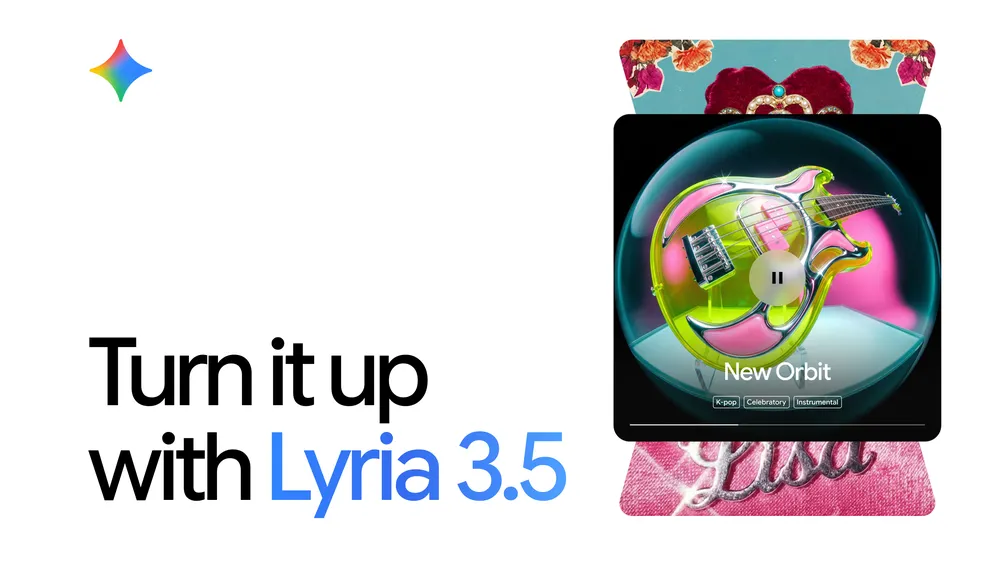
Google Lyria 3.5 is focusing on musical organization rather than pure unpredictability. Released in the Gemini app and Gemini API on September 4, 2026, the model is delivering fuller songs with more expressive vocals, richer arrangements, and improved fidelity. Google is making the model available through Gemini, Google AI Studio, Google Vids, and Flow Music, giving it reach across consumer, developer, and content-production workflows.
The official Google announcement for Lyria 3.5 describes the model as Google’s best-sounding music generation system to date. For producers, the most important improvements are not simply tonal quality; they are the increased ability to direct what happens over time.
Song structure: Lyria 3.5 is handling intros, verses, choruses, bridges, and outros with greater consistency. This is helping prompts behave more like an arrangement brief than a loose mood description.
Tempo control: Producers can specify a BPM and use tempo as a deliberate production parameter rather than relying on vague instructions such as “slow” or “energetic.”
Vocal fidelity: The model is improving pronunciation, emotional expression, lyric adherence, and the relationship between vocals and backing arrangements.
Full-length generation: Lyria 3.5 is moving beyond short demonstrations, producing tracks that can extend to approximately three minutes depending on the workflow and request.
Developer access: Through the Gemini API music-generation documentation, developers can build music creation into applications, content tools, and custom production systems.
Lyria 3.5 is becoming particularly attractive for creators who need a defined song shape. A prompt that specifies genre, key, BPM, instrumentation, vocal approach, and section timing is giving the system a clearer production brief. This is useful for a video producer who needs a track to fit a specific duration, or a songwriter who wants a verse and chorus to arrive at predictable points.
Google is also applying SynthID watermarking to generated audio, supporting provenance and identification of AI-created material. As generative music is entering professional media pipelines, that type of transparency is becoming increasingly important.
Our earlier coverage of Google Lyria’s evolution in music creation provides additional context for how the platform is developing from short-form generation toward more structured production.
ElevenLabs Music v2.5: the naturalness specialist
ElevenLabs Music v2.5 is placing audio realism and commercial usability at the center of its update. The model is now the default for prompted and reference-based generation in ElevenMusic, while also being available in ElevenCreative and the ElevenLabs API.
According to ElevenLabs’ official announcement, v2.5 is producing more layered and complex songs, with instruments that sound closer to a live performance. The company says a blind test covering 47,885 pairs of generations favored v2.5 over the previous version in the majority of comparisons, with especially strong improvements in vocal-led and acoustic-heavy genres.
Natural instruments: Guitars, drums, orchestral parts, and other instruments are gaining more realistic movement and interaction, helping arrangements feel less like isolated generated layers.
Richer arrangements: Tracks are developing more depth and variation from section to section, supporting a stronger sense of progression across a complete song.
Vocal and acoustic genres: R&B, soul, hip hop, rock, metal, orchestral, and cinematic music are among the areas where ElevenLabs is reporting its largest improvements.
App and API access: Music v2.5 is available through ElevenMusic for direct creation and through the ElevenLabs API for integration into products and production workflows.
Commercial permissions: ElevenLabs states that creators own what they make, with free-plan commercial use requiring attribution to ElevenMusic. Lossless downloads are also available across plans, subject to the platform’s terms.

ElevenLabs is therefore becoming the strongest candidate for commercial content teams that value natural instrumental texture and a clear licensing position. A filmmaker, advertising producer, or game-audio team can generate a track in the app, test it in a broader ElevenCreative workflow, or call the model programmatically through the API.
The platform is not necessarily offering the same model variety as Suno, but its more focused approach can be an advantage. Instead of choosing between several creative personalities, we are working with a model designed to deliver a consistently polished result.
Which AI music generator should producers choose?
The best choice is depending on where the music is entering the production process. These models are becoming more specialized, so the right decision is less about finding one universal winner and more about matching each platform to a specific creative task.
Choose Suno v6 for songwriting and exploration: Suno is the strongest fit when we want many directions quickly, from polished pop songs to unusual genre combinations. Its v6-wild model is particularly useful for finding ideas we would not have written ourselves.
Choose Google Lyria 3.5 for structured briefs: Lyria 3.5 is a strong choice when BPM, sections, duration, vocals, and arrangement need to follow a clear plan. Its Gemini and API integration is also valuable for developers building custom creative tools.
Choose ElevenLabs Music v2.5 for natural production texture: ElevenLabs is appealing when the realism of instruments and the practical use of the final file are the top priorities. It is particularly well suited to branded content, video scoring, podcasts, and commercial media.
Use more than one platform for pre-production: A producer might use Suno v6-wild to discover a concept, Lyria 3.5 to test a structured arrangement, and ElevenLabs Music v2.5 to explore a more natural acoustic interpretation.
Move the strongest generation into a DAW: These systems are creating increasingly complete tracks, but final editing, vocal treatment, balance, dynamics, and delivery still benefit from human production decisions.
This final step is where ai mixing remains essential. Generative platforms can create a convincing stereo file, but professional releases still require attention to frequency balance, headroom, vocal placement, transient control, and translation across playback systems. Tools such as OSMIX and AI mastering workflows can assist with that stage without removing the producer from the decision-making process.

Final verdict: specialization is becoming the advantage
The key takeaway is that Suno v6, Google Lyria 3.5, and ElevenLabs Music v2.5 are advancing in different directions. Suno is making generation more exploratory and editable. Google is making the Google Lyria 3 family more structured, controllable, and accessible through an expanding developer ecosystem. ElevenLabs is improving the naturalness and commercial practicality of AI-generated music.
For most producers, Suno v6 is the best all-purpose creative laboratory. Lyria 3.5 is the more disciplined choice for structured compositions and API-driven workflows. ElevenLabs Music v2.5 is the strongest option when natural instrumental performance and commercial deployment are the deciding factors.
As we look ahead, these tools will increasingly function as connected stages in a larger production chain: idea generation, arrangement, revision, sound design, ai mixing, and mastering. The producers gaining the most value will not simply be asking which model sounds best. They will be building workflows that use each model’s strengths while keeping human taste, editing, and musical judgment at the center.
Sources