Sonorie Turns Text Prompts Into Working VST Plugins: The AI Plugin Builder Explained
Music software is stepping into a new phase: producers are no longer only choosing plugins, they are beginning to describe them. Sonorie is putting that idea into practice with a subscription-based service that turns plain-language prompts into working VST3, AU, and CLAP plugins.
The launch is arriving as AI is reshaping nearly every part of music production software. However, Sonorie is taking a different route from an AI music generator: it is not creating finished songs or audio files. Instead, it is generating the DSP code and software structure behind custom instruments and effects.
For producers, that could mean moving from “I wish there were a plugin that did this” to a playable prototype within minutes. The more important question is whether those prototypes can become reliable studio tools.

Sonorie’s launch workflow is designed around describing an effect or instrument in natural language. Image: We Rave You.
What Sonorie is building
Sonorie is positioning itself as an AI plugin builder rather than a conventional music generator. Users can describe an effect or playable instrument in a chat-style interface, and the service generates the underlying code, compiles it, and presents a browser-based preview.
The company’s examples range from practical studio processors to synthesizers: warm tape saturation, vintage opto compressors, ping-pong delays, shimmer reverbs, polyphonic synths, FM electric pianos, and filter designs inspired by classic analog circuits. Sonorie says the exported plugins can run on Windows, macOS, and Linux, giving the concept relevance across professional and home-studio environments.
The central promise is ownership. According to Sonorie and launch coverage from We Rave You, the exported plugin is yours to keep and sell. The service also provides the C++ source used to build the plugin, which gives technically experienced users a way to inspect or modify the result.
That makes Sonorie different from a preset generator or an audio toy. It is attempting to create a complete piece of music production software that can be loaded into a DAW alongside established tools from companies such as FabFilter, u-he, Arturia, and iZotope.
How Sonorie turns a text prompt into a plugin
The workflow is moving several traditionally separate development stages into one conversational process. A producer begins with a description such as “a warm, tube-saturated vintage opto compressor,” rather than starting with C++ code, a plugin framework, and a detailed DSP specification.
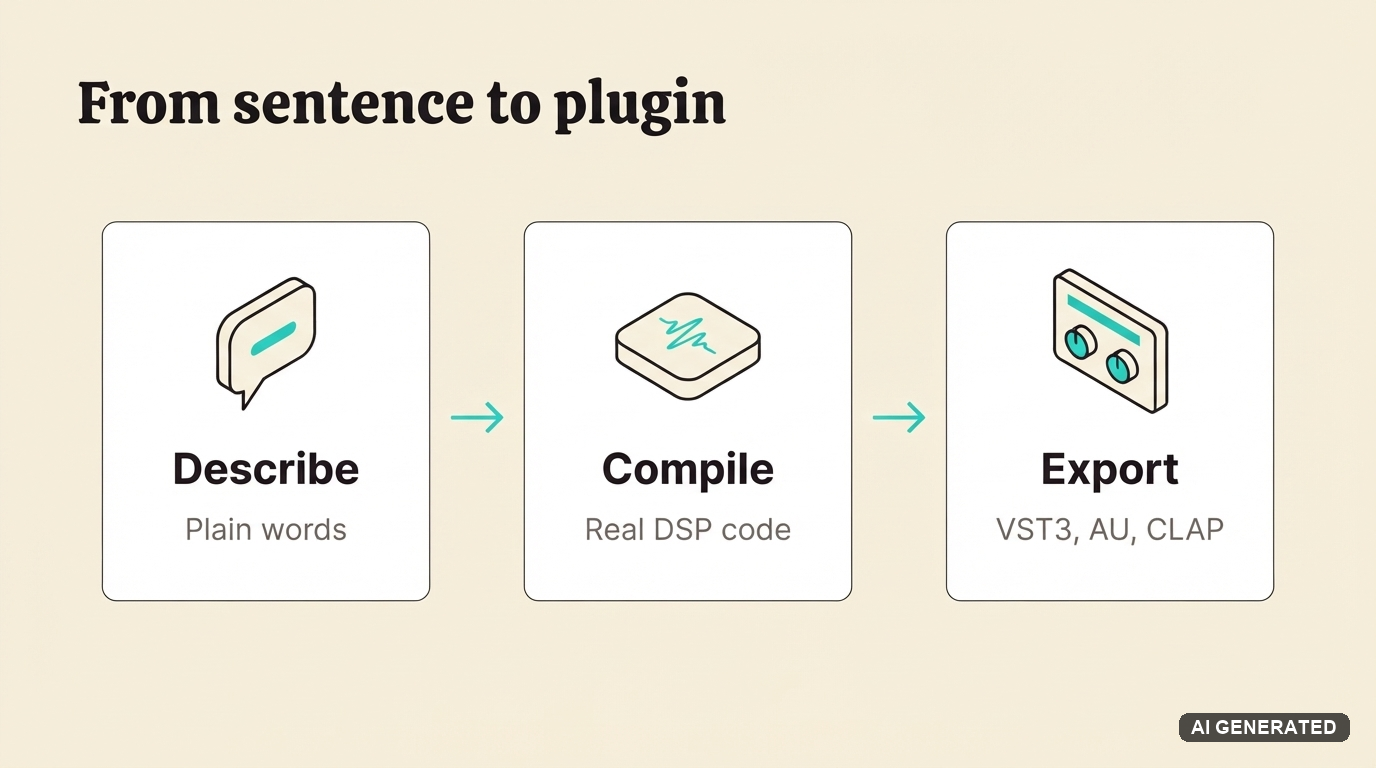
Sonorie describes its process as a sequence from natural-language prompt to DSP code, browser preview, and exported plugin. Image: AI Musicpreneur.
Sonorie’s published workflow includes several important steps:
This iterative approach is crucial. The first generation is unlikely to be the final instrument or effect, but the ability to refine a working build conversationally is what could make the platform useful in real production workflows.
What producers can create with Sonorie
The platform is most compelling when it is solving a specific production problem rather than trying to replace an entire commercial plugin catalog. A producer may need an unusual transient shaper, a filter with a particular resonance curve, or a simple utility that is too niche for a major developer to release.
Potential applications include:
This is where Sonorie could become more than a novelty. It is enabling producers to convert personal workflow knowledge into custom tools, especially when those tools are too specialized to appear among the best VST plugins available commercially.
Sonorie is not an AI music generator
The distinction between generating music and generating music software is becoming increasingly important. Platforms such as Suno, Udio, and Google Lyria are producing songs or musical passages. Sonorie is generating code that processes audio supplied by the user.
That difference changes the creative role of the producer. With a song-generation system, the user is directing an output. With Sonorie, the user is describing a tool and then using that tool to make decisions inside a DAW. The process is closer to assisted software development than automatic composition.
It also changes the evaluation criteria. A generated song can be judged by its arrangement, performance, and mix. A generated plugin must be judged by stability, latency, parameter behavior, CPU use, sonic consistency, automation, preset handling, and compatibility across hosts.
Sonorie says its internal S1 model is trained for audio DSP and plugin design. The service reportedly uses S1 Pro for more complex builds and S1 Mini for simpler requests. According to the company’s technical discussion on Gearspace, generated processors are tested for frequency response, phase behavior, harmonic distortion, aliasing, and real-time safety.
Those checks are encouraging, but they do not automatically make every result production-ready.
The limitations producers should understand
A plugin that compiles is not necessarily a plugin that belongs on a mix bus. Sonorie’s own representatives acknowledge that the service is not replacing an experienced DSP engineer on a flagship commercial product. The quality of the prompt, the complexity of the request, and the refinement process will all influence the result.
Key limitations include:
These limitations are not arguments against the technology. They are reminders that AI is assisting the development process, not removing the need for critical listening, testing, and responsible release practices.
Pricing, ownership, and the marketplace model
Sonorie is selling access to an ongoing generation service rather than a one-time plugin license. The entry subscription costs $19.99 per month, with no free tier currently available. The company says the price reflects the compute required to generate, compile, test, and refine each build.

Sonorie’s marketplace was presented as a place where users could sell generated plugins, although launch coverage showed no listings initially. Image: AI Musicpreneur.
The commercial opportunity will depend on two things: whether generated plugins can reach a consistent quality level, and whether buyers trust independent creators enough to purchase them. The promise of keeping and selling the output gives producers an incentive to develop distinctive tools, but a marketplace only becomes valuable when those tools are curated, supported, and demonstrably useful.
For now, the most realistic use case is personal experimentation. A producer can subscribe for a month, build a few specific utilities, compare them against existing tools, and decide whether the workflow justifies continued access.
What Sonorie means for music production software
Sonorie is making plugin creation more accessible, while also raising the standard for what “finished” means. Producers who have never written C++ can now describe signal-processing ideas in ordinary language. Developers can move more quickly from concept to prototype. Sound designers can create tools around unusual workflows instead of waiting for a company to address them.
The platform will not eliminate the value of carefully engineered products. In fact, it may make professional design, testing, documentation, and support even more important as the number of generated tools increases. A plugin still has to earn a place in a producer’s template through sound, reliability, and speed.
Key takeaway: Sonorie is not replacing the best VST instruments or effects; it is creating a new path toward custom ones. Its success will depend on whether conversational generation can produce tools that are not only functional, but musically focused and dependable. As AI-assisted development continues to evolve, producers are gaining another way to turn an idea into sound: and the next stage will be learning how to judge, refine, and responsibly share what they build.
Sources